
www.waterplant.tech
15
'26
Written on Modified on
Event Duration Monitoring Radar Level Measurement
VEGA introduces MCERTS-certified radar level sensors spanning twenty metres to standardise wastewater spill detection and regulatory compliance across diverse sewer assets.
www.vega.com
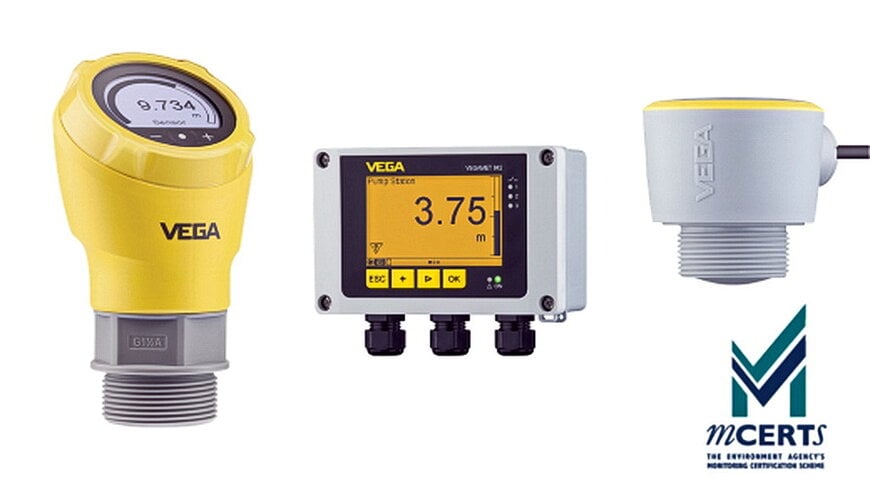
Wastewater utility operators face stringent regulatory mandates to verify when storm overflows discharge into watercourses, yet sewer network assets range widely from shallow overflow weirs to deep underground storm storage tanks. To solve the instrumentation challenges of varying asset depths, VEGA has developed an Event Duration Monitoring solution certified under the Environment Agency MCERTS scheme across a complete measuring range of 0 to 20 metres.
Wastewater Network Monitoring Challenges
Sewer catchments incorporate varied civil infrastructure, including combined sewer overflows, pumping station wet wells, retention shafts, and screening chambers. Monitoring these sites requires measuring instrumentation capable of surviving high humidity, condensation, surface turbulence, and aggressive atmospheres containing hydrogen sulphide. Historically, meeting regulatory reporting requirements across both shallow chambers and deep storage tanks required engineering teams to specify and maintain disparate sensor families with varying certification boundaries, increasing spare-parts inventories and installation complexity.
Operating Principle of Non-Contact Radar
The core instrumentation platform relies on the VEGAPULS C 21, VEGAPULS C 22, and VEGAPULS 21 and 31 non-contact radar level sensors. Non-contact radar operates on high-frequency microwave transmission, typically utilizing 80 GHz frequency modulated continuous wave radar signals. The sensor emits continuous signals toward the effluent surface, evaluates the frequency shift of the reflected echo, and calculates surface distance with millimetric precision.
Because microwaves travel independently of air temperature, vapor saturation, and atmospheric pressure, the radar method circumvents the acoustic attenuation and false echo issues common to ultrasonic level transducers. The physical housing protects internal electronics from flooding, while condensation shedding on the antenna face ensures signal integrity during high-humidity storm surcharges. For confined infrastructure where vertical clearance is limited, the VEGAPULS C 22 incorporates a side-entry cable configuration to allow mounting flush against access covers or chamber crowns.
Signal Conditioning and Calibration Architecture
The radar sensors integrate directly with the VEGAMET signal conditioning controller to deliver certified Event Duration Monitoring spill detection. While the radar maintains MCERTS performance over the full 0 to 20 metre distance, the VEGAMET controller permits operators to scale the 4 to 20 milliamp analogue current loop output across a narrower 5 metre span placed anywhere within that 20 metre window.
This functional capability allows instrumentation engineers to concentrate measurement resolution and signal sensitivity around critical spill weir crests or threshold levels while retaining the extended measuring range required to track asset fill and drainage cycles. In addition, the VEGAMET controller provides an independently certified spill alarm relay that trips on predetermined level thresholds. The controller housing features a multi-colour backlit display that shifts visual color when a spill event activates, giving field maintenance engineers instant visual verification of storm surcharge states.
Industrial Telemetry and Control Integration
To feed network monitoring models and regulatory reporting archives, the system supports multiple simultaneous communication interfaces:
Certified electromechanical relay outputs for hardwired spill threshold tripping and telemetry alarm generation.
Standard 4 to 20 milliamp analogue current loops for continuous level tracking.
Digital HART communication protocols enabling remote instrument diagnostics, echo curve verification, and device parameterization.
Direct interfacing with battery-powered low-power telemetry outstations, programmable logic controllers, and supervisory control and data acquisition architectures.
By providing a single instrument platform that conforms to Environment Agency standards across shallow interceptor sewers and 20 metre deep storage shafts, utility contractors can standardise procurement, commissioning procedures, and maintenance workflows throughout municipal wastewater drainage networks.
Additional Context
This section details technical specifications and competitive benchmarking not included in the original product announcement.
In the United Kingdom wastewater sector, Event Duration Monitoring operates primarily under Environment Agency performance standards and the Water Industry Mechanical and Electrical Specifications. Regulatory mandates under the Environment Act 2021 have accelerated the requirement for near-real-time discharge reporting across storm overflows, driving utilities to replace older float switches and ultrasonic sensors with certified continuous level instrumentation.
MCERTS certification for continuous level monitors evaluates accuracy, repeatability, response time, and temperature stability under formal test conditions. Historically, certified non-contact level sensors in the water industry maintained certified ranges typically spanning 0 to 8 metres or 0 to 15 metres, often tailored for open channel flow flumes or standard chamber depths. Deep storm storage tunnels and combined retention tanks exceeding 15 metres frequently required hydro-static pressure transducers or dual-instrument arrangements to handle both low-level dry weather flow and high-level surcharge events. Hydro-static transducers, while functional at high immersion depths, remain vulnerable to ragging, silt accumulation, and cable strain in raw sewage environments.
Extending certified non-contact 80 GHz radar performance to 20 metres eliminates mechanical contact with the wastewater while providing the measurement beam angle and dynamic range necessary to operate inside narrow, deep shafts without interference from ladders, pump chains, or chamber sidewalls.
Edited by Evgeny Churilov, Induportals Media - Adapted by AI.
www.vega.com
