
www.waterplant.tech
05
'26
Written on Modified on
Seawater Electrolysis Membranes for Offshore Hydrogen Production Systems
Fraunhofer IWES and Fraunhofer IFAM evaluate direct seawater electrolysis membranes and testing infrastructure within the SeaEly research consortium.
www.fraunhofer.de
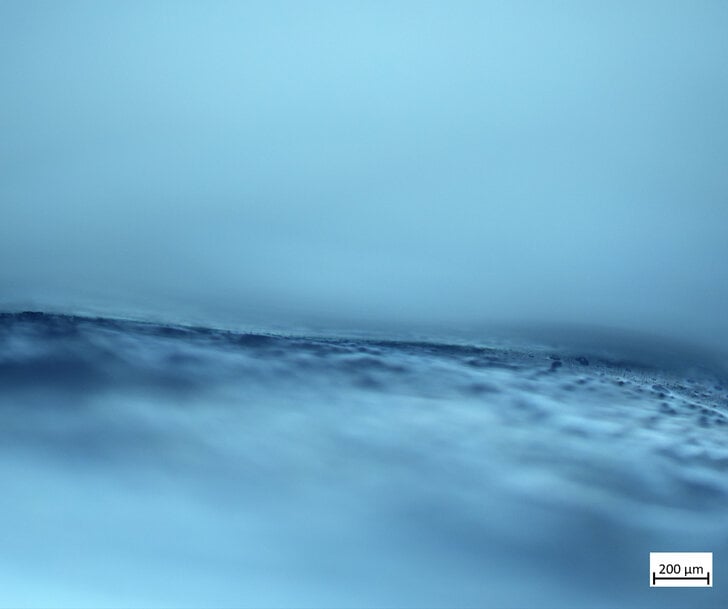
© Fraunhofer IFAM: Microscopic image of a newly developed anion-exchange membrane that was used to electro-lyze synthetic seawater, with promising results for applications in saline environments
Industrial hydrogen production via water electrolysis requires continuous supplies of high-purity deionized water to prevent rapid catalyst poisoning and cell degradation, creating operational trade-offs in water-stressed or remote regions. To eliminate complex freshwater desalination logistics in offshore and coastal wind environments, the Fraunhofer Institute for Wind Energy Systems IWES and the Fraunhofer Institute for Manufacturing Technology and Advanced Materials IFAM coordinated the SeaEly research project to develop specialized membranes and standardized electrochemical test benches for untreated seawater and brackish water electrolysis.
The Water Purity Dilemma in Offshore Hydrogen Generation
Scaling green hydrogen infrastructure directly adjacent to offshore wind farms allows wind power to be converted on site into storable energy carriers, feedstock chemicals, ammonia, or synthetic fuels. However, operating conventional proton exchange membrane (PEM) or alkaline electrolysis stacks on raw marine water introduces harsh chemical and electrochemical complications. Untreated seawater contains complex mixtures of dissolved minerals, suspended organic matter, and high concentrations of chloride ions.
Under an applied electric potential, chloride ions compete directly with the oxygen evolution reaction (OER) at the anode, generating corrosive hypochlorite and chlorine gas instead of pure oxygen. Furthermore, dissolved calcium and magnesium cations migrate across the electrical double layer and precipitate as insoluble scale on catalyst surfaces and gas diffusion layers, causing rapid cell failure and severe membrane fouling.
Electrochemical Membrane Separation and Degradation Analysis
During the electrochemical splitting of water molecules into gaseous hydrogen and oxygen, the membrane fulfills two critical transport functions: it conducts specific ions between the anode and cathode chambers to complete the electrical circuit while serving as an impermeable physical barrier to keep generated product gases separated. When using untreated seawater, structural durability and selective transport become paramount to prevent cross-contamination and internal shorting.
To mitigate degradation pathways, Fraunhofer IFAM developed customized membrane materials engineered to operate in untreated salt-water electrolytes. Evaluation of these materials is performed on a modular electrochemical test bench that subjects candidate membranes to dynamic operating loads, temperature variations, and cyclic flow regimes.
Post-test degradation analysis isolates the precise chemical and physical mechanisms of material breakdown. Fraunhofer IFAM combines in-situ electrochemical measurements with advanced surface characterization techniques:
Industrial hydrogen production via water electrolysis requires continuous supplies of high-purity deionized water to prevent rapid catalyst poisoning and cell degradation, creating operational trade-offs in water-stressed or remote regions. To eliminate complex freshwater desalination logistics in offshore and coastal wind environments, the Fraunhofer Institute for Wind Energy Systems IWES and the Fraunhofer Institute for Manufacturing Technology and Advanced Materials IFAM coordinated the SeaEly research project to develop specialized membranes and standardized electrochemical test benches for untreated seawater and brackish water electrolysis.
The Water Purity Dilemma in Offshore Hydrogen Generation
Scaling green hydrogen infrastructure directly adjacent to offshore wind farms allows wind power to be converted on site into storable energy carriers, feedstock chemicals, ammonia, or synthetic fuels. However, operating conventional proton exchange membrane (PEM) or alkaline electrolysis stacks on raw marine water introduces harsh chemical and electrochemical complications. Untreated seawater contains complex mixtures of dissolved minerals, suspended organic matter, and high concentrations of chloride ions.
Under an applied electric potential, chloride ions compete directly with the oxygen evolution reaction (OER) at the anode, generating corrosive hypochlorite and chlorine gas instead of pure oxygen. Furthermore, dissolved calcium and magnesium cations migrate across the electrical double layer and precipitate as insoluble scale on catalyst surfaces and gas diffusion layers, causing rapid cell failure and severe membrane fouling.
Electrochemical Membrane Separation and Degradation Analysis
During the electrochemical splitting of water molecules into gaseous hydrogen and oxygen, the membrane fulfills two critical transport functions: it conducts specific ions between the anode and cathode chambers to complete the electrical circuit while serving as an impermeable physical barrier to keep generated product gases separated. When using untreated seawater, structural durability and selective transport become paramount to prevent cross-contamination and internal shorting.
To mitigate degradation pathways, Fraunhofer IFAM developed customized membrane materials engineered to operate in untreated salt-water electrolytes. Evaluation of these materials is performed on a modular electrochemical test bench that subjects candidate membranes to dynamic operating loads, temperature variations, and cyclic flow regimes.
Post-test degradation analysis isolates the precise chemical and physical mechanisms of material breakdown. Fraunhofer IFAM combines in-situ electrochemical measurements with advanced surface characterization techniques:
- Scanning electron microscopy (SEM) to document surface morphology, micro-fracturing, and localized pitting.
- Energy-dispersive X-ray spectroscopy (EDX) to map compositional shifts and elemental accumulation across the active surfaces.
- X-ray photoelectron spectroscopy (XPS) to analyze oxidation states and chemical changes within thin interfacial layers.
- Time-of-flight secondary ion mass spectrometry (TOF-SIMS) to detect trace elemental deposition and ion penetration depths inside the membrane bulk.
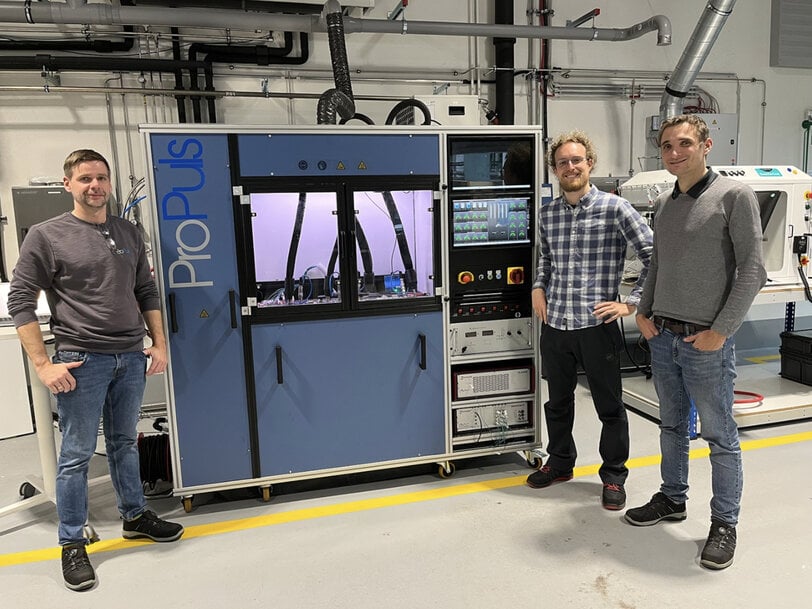
© Fraunhofer IWES: Pilot test bench for analyzing electrolysis stacks using various electrolytes at Fraunhofer IWES
Multipurpose Scaled Testing Architecture for Industrial Electrolyzers
Complementing material-scale diagnostics, Fraunhofer IWES constructed a multipurpose test bench at the Hydrogen Lab Leuna. This platform accommodates diverse stack architectures, allowing side-by-side comparative testing of proton exchange membrane (PEM), alkaline water electrolysis (AWE), and anion exchange membrane (AEM) technologies under variable salinity profiles.
The multi-tier test methodology facilitates the migration of proven membrane chemistries from single-cell laboratory devices to larger multi-cell stacks. This enables engineers to assess inter-component interactions, seal degradation, and localized mass-transport phenomena under representative industrial flow conditions.
Consortium Framework and Commercial Availability
The SeaEly initiative operated from October 2022 through March 2026 under the German Federal Government's Hydrogen Republic of Germany ideas competition, receiving financial support from the German Federal Ministry of Research, Technology and Space (BMFTR). Led by Fraunhofer IWES as primary coordinator, the consortium brought together material scientists, manufacturing experts, and logistics researchers from Fraunhofer IFAM, Technische Universität Berlin, Whitecell Eisenhuth GmbH & Co. KG, and the Institute of Shipping Economics and Logistics.
With the conclusion of the initial development phase, the collaborative testing platforms are permanently operational across both Fraunhofer institutes. The infrastructure is configured to deliver systematic aging evaluations, corrosion assessments, and component qualification services for third-party commercial electrolyzer manufacturers targeting non-potable water electrolysis.
Additional Context:
This section details technical specifications and competitive benchmarking not included in the original product announcement.
Direct seawater electrolysis systems must circumvent standard water purification protocols defined by ASTM D1193 Type II standards, which demand an electrical resistivity greater than 1.0 megohm-centimeter and strict limits on total organic carbon. Seawater typically contains approximately 35 grams per liter of total dissolved solids, including nearly 19 grams per liter of chloride ions, which drastically alters cell thermodynamics and reaction selectivity.
In commercial green hydrogen plants, standard water consumption ranges from 9 to 11 kilograms of ultra-pure deionized water per kilogram of hydrogen produced. Conventional reverse osmosis (RO) desalination trains consume between 2.5 and 4.0 kilowatt-hours of electrical energy per cubic meter of purified water produced, adding mechanical complexity, parasitic auxiliary loads, and marine footprint constraints to offshore wind-turbine substructures.
Engineering efforts across the sector focus heavily on Anion Exchange Membrane (AEM) and modified PEM architectures. State-of-the-art benchmark approaches typically employ selective catalyst coatings, such as manganese oxide or layered double hydroxide (LDH) passivating barriers, to suppress the chlorine evolution reaction (CER) at an overpotential threshold below 1.36 volts versus the standard hydrogen electrode (SHE). Testing protocols established under the SeaEly framework evaluate stack durability against international electrolyzer performance standards, including ISO 22734 requirements for industrial water electrolysis generators.
Edited by Natania Lyngdoh, Induportals editor, with AI assistance.
www.fraunhofer.com
