
www.waterplant.tech
23
'26
Written on Modified on
SUEZ advances construction of major desalination plant in Jordan
The project will strengthen Jordan’s water security by providing drinking water to 40% of the country’s population through what is set to become the world’s second-largest desalination facility.
www.suez.com
Jordan ranks among the most water-scarce nations globally, with renewable freshwater availability falling below 100 cubic meters per capita per year—well under the international threshold for absolute water scarcity. Rapid demographic expansion, regional refugee inflows, and climate-induced reductions in precipitation have severely depleted inland fossil aquifers and overtaxed municipal distribution networks. Because Jordan’s sole coastal outlet lies at the southern tip of the country along the Gulf of Aqaba, securing a climate-independent municipal water supply for inland population centers like Amman requires transporting vast volumes of desalinated seawater hundreds of kilometers inland across steep topographic elevation gradients. Executing such a mega-project demands integrated build-operate-transfer (BOT) financing, high-efficiency reverse osmosis plants, long-distance high-pressure pumping pipelines, and dedicated renewable power generation to stabilize lifecycle water tariffs.
Mega-Scale Desalination, Long-Distance Pipeline, and Solar Integration
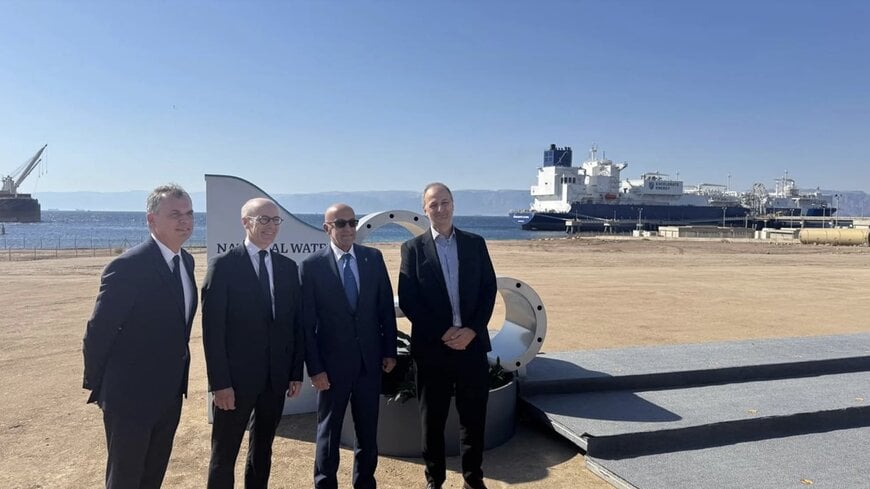
During the EU-Jordan Investment Conference, His Royal Highness Prince Faisal bin Al Hussein laid the foundation stone for the Aqaba-Amman Water Desalination and Conveyance Project, marking the official start of a four-year single-phase construction program. The ceremony was attended by Raed Abu Al-Soud, Jordan’s Minister of Water and Irrigation; Nicolas Forissier, French Minister Delegate for Foreign Trade and Investment Attractiveness; Franck Gellet, French Ambassador to Jordan; Thierry Déau, Founder and Chairman of Meridiam; and Xavier Girre, Chief Executive Officer of SUEZ.
Representing an investment exceeding USD 6.7 billion, the integrated infrastructure program encompasses three primary engineering components:
- Seawater Desalination Plant: Located on the shores of the Gulf of Aqaba, the facility will produce 851,000 cubic meters of potable water per day (approximately 300 million cubic meters annually), ranking as the world’s second-largest desalination facility upon completion.
- Water Transmission Network: A 418-kilometer conveyance pipeline equipped with high-head pumping stations will transport desalinated water northward from Aqaba to Amman and surrounding governorates.
- Captive Renewable Generation: A dedicated 280 MW solar photovoltaic power plant will supply roughly 30 percent of the integrated system’s electrical energy demand, reducing fossil-fuel exposure and lowering carbon intensity.
30-Year Concession Model and National Water Security
Once operational, the project will deliver potable water to roughly 40 percent of Jordan’s population, serving as a foundational pillar of national water security for the Hashemite Kingdom of Jordan. The project is being executed by an international and regional consortium led by infrastructure investor Meridiam and water utility specialist SUEZ. Under a 30-year concession agreement, the consortium assumes full lifecycle responsibility for financing, engineering design, construction, operation, and maintenance across the desalination plant, water conveyance pipeline, and solar photovoltaic assets.
Edited by Romila DSilva, Induportals Editor, with AI assistance.
